Established 1808
The Fort
Old Fort Madison was the first permanent United States military post on the Upper Mississippi River. It was built in the years after the Louisiana Purchase, fought through the War of 1812, and was burned by its own garrison in 1813. What stands on the riverfront today is a careful reconstruction of that frontier post.
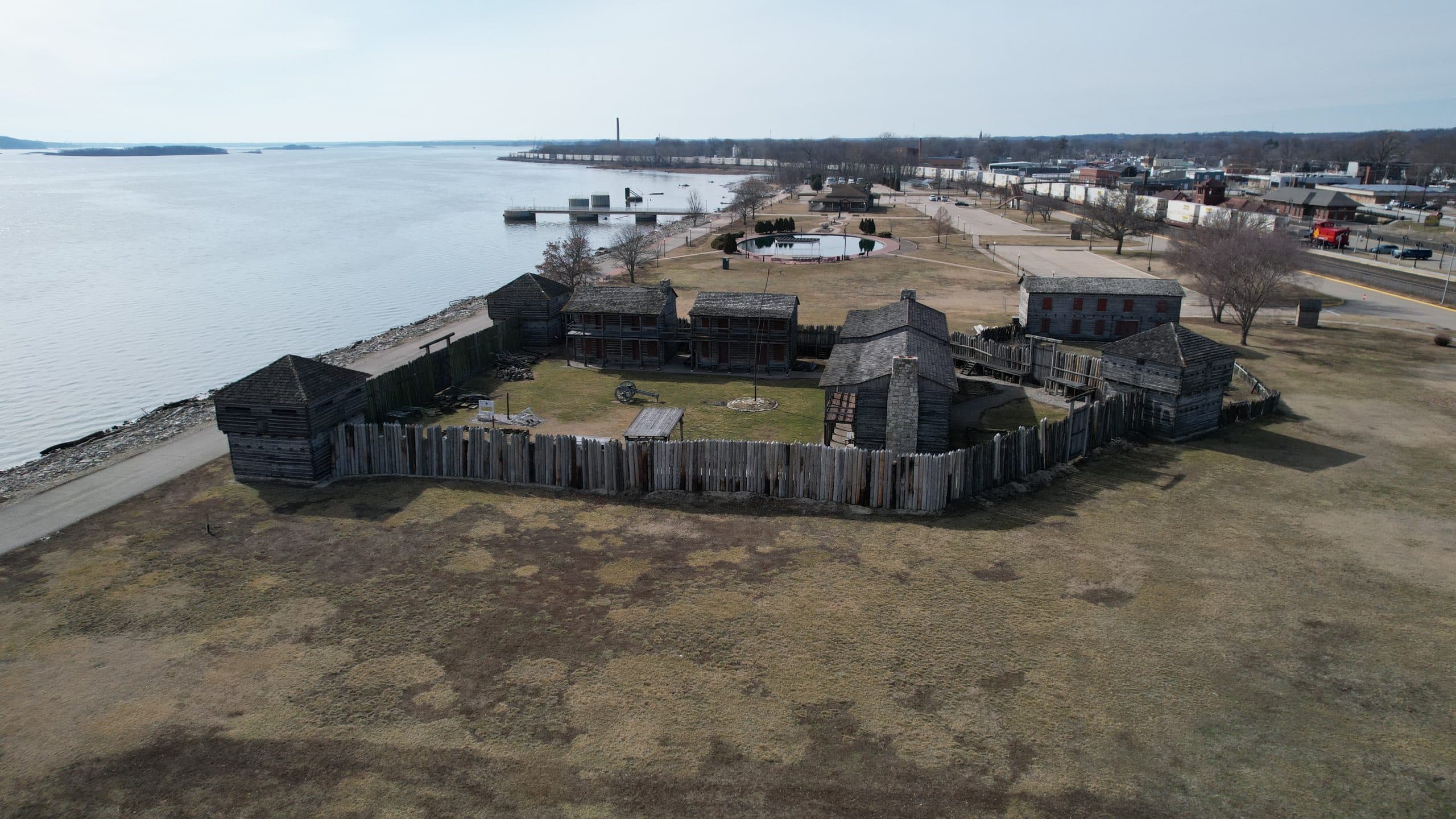
Points of interest
- The river and evacuation route
- The Mississippi was Fort Madison's principal transportation and supply route. In November 1813 the garrison evacuated the post by boat after its supply situation became untenable as winter approached. The November 1813 evacuation
- A corner blockhouse
- Timber blockhouses stood at the corners and rose above the walls, so defenders could fire along the palisade and out at attackers. Historic structures
- The palisade
- A wall of upright logs enclosed the post and tied the corners together. It was the line the September 1812 attackers fired on for four days without carrying it. Historic structures
- The parade ground and flagstaff
- The open ground at the center is where the garrison drilled and the flag flew, the flag Black Hawk later claimed to have shot down. Black Hawk and the flag
- The barracks
- Inside the walls stood the barracks and officers' quarters that housed the garrison of about sixty soldiers. Historic structures
- The trading house
- The fort included a government trading house where goods were exchanged with Native nations. Trade was part of the post's purpose. Historic structures
At a glance
A frontier post on the Mississippi
A few facts to orient you before the longer story.
The fort was one of three posts the United States planted in the West after the Louisiana Purchase, alongside Fort Belle Fontaine near St. Louis and Fort Osage near present-day Kansas City. It was meant to anchor American authority and trade on a river that the country had only recently come to claim.
Its location worked against it from the start. The post sat at the base of a bluff next to a ravine, ground from which attackers could fire down on the garrison. That weakness shaped every fight the soldiers had here and the way the story ended.
Explore the section
Go deeper
Five pages cover the fort from its founding to the ground beneath the reconstruction.
- The Fort
History
The full narrative from Fort Bellevue in 1808 to the living-history site on the riverfront today.
Read more - The Fort
Timeline
Key dates at a glance, from the 1808 founding to the present day.
Read more - The Fort
War of 1812
The attacks of 1812 and 1813, Black Hawk, the breakdown of the fort's supply system, and the November 1813 evacuation.
Read more - The Fort
Archaeology
How a 1965 dig in a parking lot found the central blockhouse and led to National Register listing in 1973.
Read more - The Fort
Historic Structures
The five-cornered plan, the blockhouses, barracks, palisade, and trading house, and what visitors see today.
Read more