Capital Campaign
A permanent home for a defining story
When the campaign is finished, Old Fort Madison will be a year-round living-history site with a Welcome Center/Living History Center built to last, on the spot where the first United States fort on the Upper Mississippi once stood.
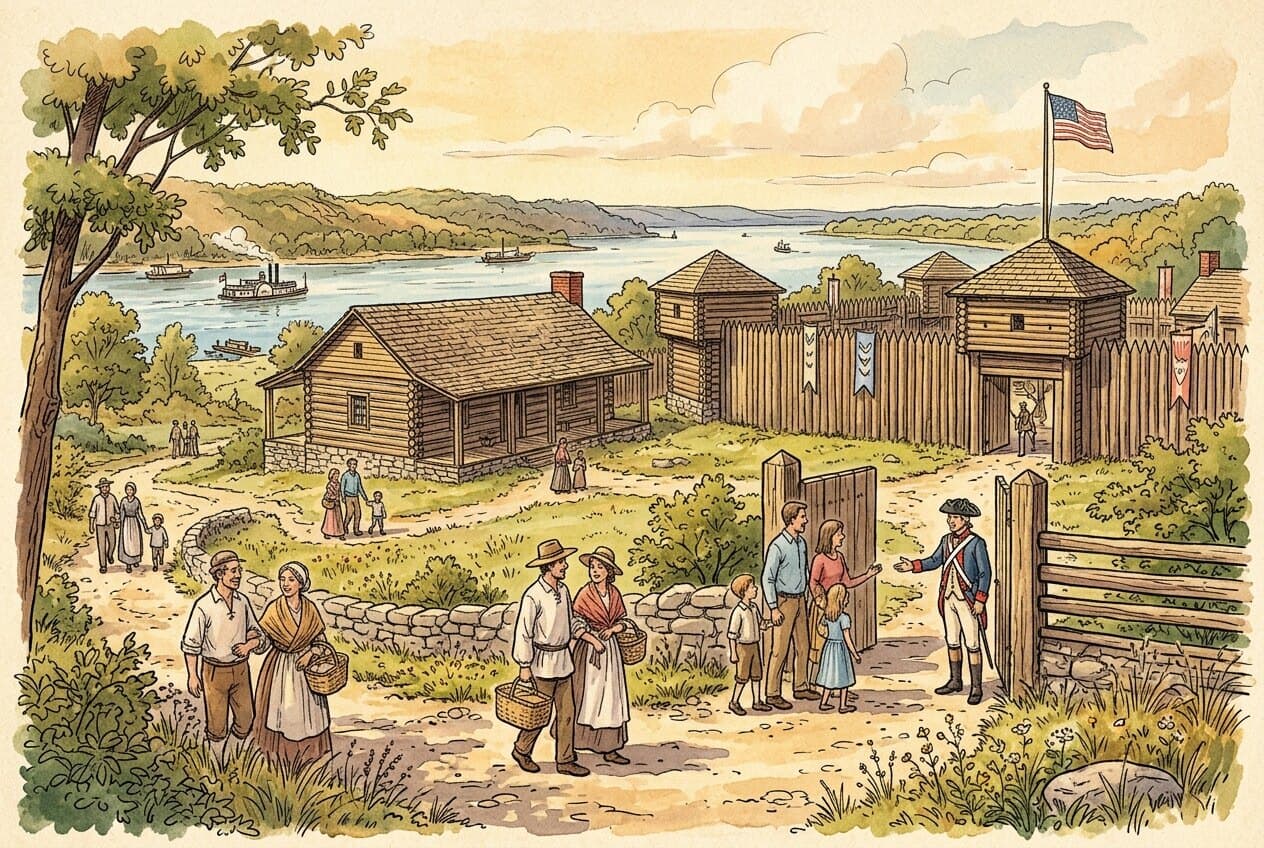
Open year round
A Welcome Center/Living History Center that does not close for the season, so visitors, families, and groups can come whenever they are ready.
Tells the real story
The 1808 post, the attacks of 1812 and 1813, Black Hawk, the November 1813 evacuation, and the 1965 dig that found the blockhouse, told accurately and in full.
Welcomes everyone
Accessible routes, clear signage, and programs built for students, scholars, and first-time visitors alike.
What the finished site will be
Today the fort comes alive in summer, with tours, reenactments, and programs on the Mississippi riverfront. The campaign turns that seasonal experience into a place you can count on year round.
At the center of the plan is a new Welcome Center/Living History Center. It gives every visit a clear starting point: a place to park, to find a restroom, to gather a group, and to meet a guide before stepping out to the rebuilt walls. It is also where the story begins, through exhibits that carry visitors from the founding in 1808 to the attacks of the War of 1812 and on to the 1965 dig that brought the fort back into public memory.
From the Welcome Center/Living History Center, paths lead out to the reconstructed fort and along the riverfront. The grounds work in the plan makes those routes accessible and clearly marked, so a family with a stroller, a visitor using a wheelchair, and a busload of fourth graders can all move through the site with ease.
Why it matters
This was the first permanent United States military post on the Upper Mississippi River, one of three built after the Louisiana Purchase, alongside Fort Belle Fontaine near St. Louis and Fort Osage near present-day Kansas City. It endured repeated attacks during the War of 1812 and was evacuated in November 1813 after Native resistance, serious provisioning failures, and the approach of winter made continued occupation increasingly difficult. The soldiers burned the fort before withdrawing down the Mississippi. For more than a century, little marked the spot but the chimneys the Sauk leader Black Hawk remembered.
A story this specific deserves a place that does it justice. A year-round site keeps the history in front of the community that carries it, supports the school programs that pass it to the next generation, and gives travelers along the river a real reason to stop. It also protects the work already done, from the reconstructed walls raised in the mid-1980s to the artifacts in the collection.
What we are asking for
The $3.5 million campaign funds the build itself: raising the site above the flood plain, the Welcome Center/Living History Center, the exhibits, the education space, and the grounds and trail work that ties it all together. It is a one-time investment in a site that will serve visitors for generations. The next page lays out exactly how the work is phased.